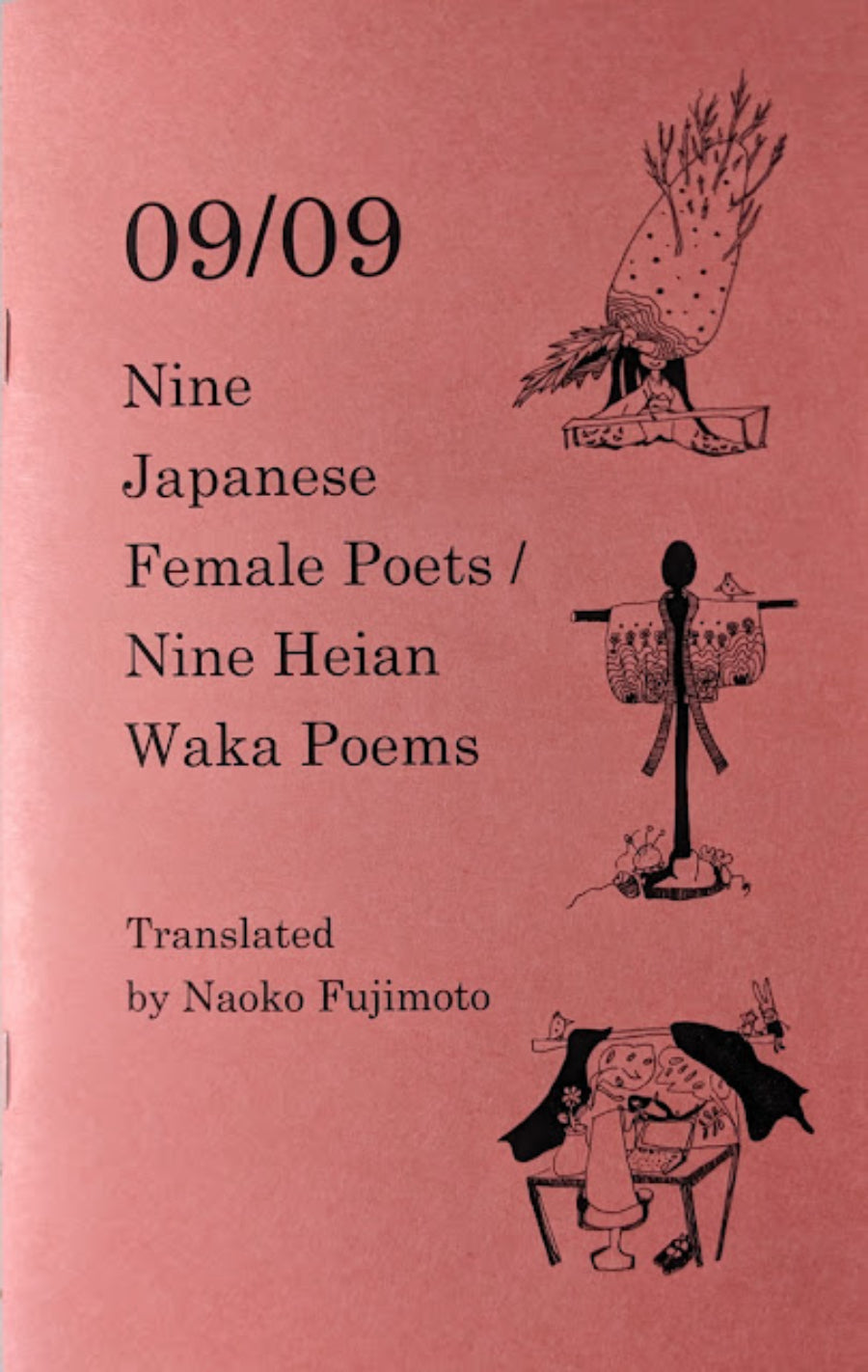
09/09: Nine Japanese Female Poets
09/09: Nine Japanese Female Poets
Nine Heian Waka Poems
Couldn't load pickup availability
DETAILS
DETAILS
Translated by Naoko Fujimoto
Toad Press/Veliz Books
Chapbook
21 pp
9/2024
This collection translates Japanese poems from the 7th century to the 12th century.
According to the translator, "I’ve selected seventeen female poets from this period when Japanese women’s literature flourished. Famous writers from the era include Sei Shōnagon (The Pillow Book) and Murasaki Shikibu (The Tale of Genji). I’ve introduced some lesser-known female poets to this collection. Their writing enormously influenced not only Japanese literary history, but also literature around the world.
Many Japanese female writers were nameless back then. They were commonly referred to as “Someone’s Mother” or “Someone’s Daughter.” Even Murasaki Shikibu is a nickname people created after her death. The date of Sei Shōnagon’s death is unknown because she left the palace when her empress lost political status. However, they indeed left beautiful, delicate works. These comprised early Japanese literature.
Waka compacts much information in a short form – words with double meanings, unfamiliar phrases, habits foreign to non-Japanese speakers, and hidden historical backgrounds – so it would be hard to understand these authors’ full intent by simply reading direct translations. Therefore, my project has three approaches:
1) I create a short essay before each waka translation. The short essay, written in the Haibun style, supports the waka and the author’s background. Those paragraphs are not translations. I also provide a historical context to help readers understand the waka translation on a deeper level.
2) My translation applies a visual narrative. It is a text collage to maximize translating the author’s intention. In addition, written waka was common for house decorations back then, so the line breaks varied from piece to piece and were not historically five lines per stanza, which is a widely published format in English-speaking countries. I aim to restore some of the freedom of form in which these original works were made.
3) The phonetics of the original waka are one-of-a-kind. I would like readers to experience this. Therefore, I added a Romanized sentence along with the original Japanese composition."